Behold, our second two-vote-receiver in the favorite indie comics of the ’90s poll…and it’s a title I’m pretty sure you’re all familiar with:
Gen 13 (Image Comics, 1994)
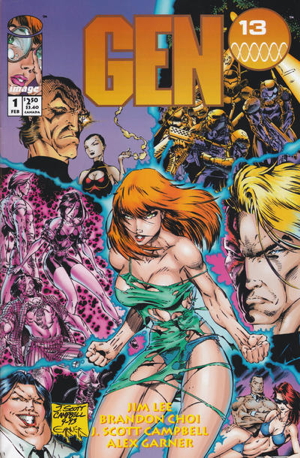 Even as the comics industry was starting to collapse all around us at the time, there were still the Hot Items that would hit the shelves and excite the comic readers who remained and toughed things out. Sure, shops were beginning to rely on POGs and Magic The Gathering cards to help shore up the sales that slipped far away from the Milk ‘n’ Honey times of the then very recent past, but there was still the occasional glimmer of hope on the stands yet.
Wizard Magazine, the comics industry hype man for all things new, popular, and investible, was at the height of its powers then, putting a price guide into the hands of The Common Man, versus that comparatively stodgy annual Overstreet Price Guide. And it would get the word out about all the Hot New #1s coming from your favorite publishers!
This was the world into which Gen 13 was unleashed. Nominally a super-team book, the initial mini-series introduced* to us Grunge, Free-Fall, Rainmaker, Fairchild, and Burnout, all superpowered teens. They are accompanied by the older, militarily-trained John Lynch. The initial five-issue mini-series was a hit, necessitating a second printing of the first issue. The youthful team, written by Jim Lee and Brandon Choi, featured the major selling point of J. Scott Campbell’s dynamic art. The exaggeratedly-legged and improbably-torsoed caricatures of the ladies read as “sexy” to potential readers, giving also-youthful comic fans an energetic and mildly-sensual alternative to boring ol’ comics aimed at their grandfathers, like Avengers and Justice League. This was a book for today’s mid-1990s young adult fans!
Given the mini’s popularity, an ongoing series was launched in 1995, with the relatively infamous thirteen variants for the first issue (discussed here). Trust me, for folks reading this who are newer to comics, at one time in the industry’s history “thirteen variants” actually seemed like a lot. But beyond everything else, those variants presented a cheeky sense of humor and a willingness to do some wild stuff with their comics. Of note in the second series is the three-part issue #13 (released as #13A, #13B, and #13C) in which Gen 13 crossed over with other companies’ characters, such as Jeff Smith’s Bone and, kinda surprisingly, the Archie Comics gang.
The second series continued on for 77 issues (plus a #0 mixed in there somewhere), wrapping up in 2002. With #37 the book became part of the Wildstorm imprint at DC Comics, and by this point the original creative team had left, leaving a variety of characters to carry on the book. Most notably, Adam Warren, of Empowered and Eclipse’s Dirty Pair fame, took over writing and cover art chores on the series, with interiors by Rick Mays, Ed Benes, and others, with the book concluding under his watch.
Along the way there were a number of tie-ins and spin-offs, most notably the anthology title Gen 13 Bootleg (which includes a story or two written and drawn by Warren, probably the best sellers from this run, at least at our shop). I mean, there were tons of them, and I’m just going to point you to the lists here and here instead of trying to transcribe every title into this post. I would like to note the Gen 13/Spider-Man intercompany crossover, as well as the Gen 13/Monkeyman and O’Brien mini, illustrated by Art Adams! Oh, and their crossover with the Maxx, and, and…well, you get the idea.
And speaking of Wizard, as we were earlier, here’s the cover to #44 from 1995, with the ladies of the team:
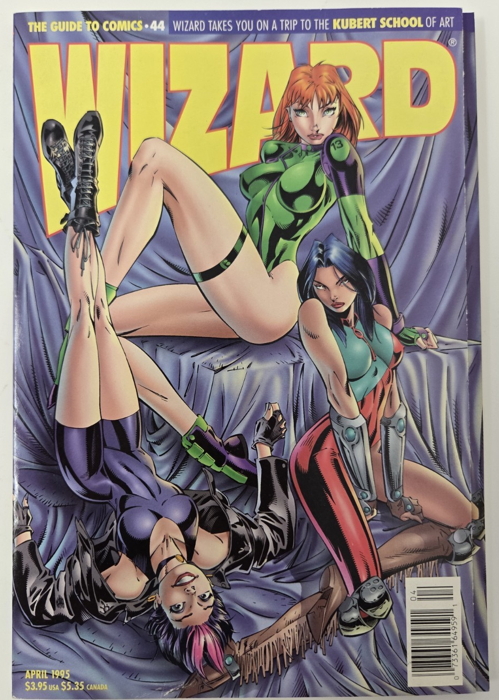
A brief aside: for all its failings, Wizard did succeed in, as I noted at the beginning of this post, hyping up comic titles to a certain core audience of readers, many of whom were new to the hobby, and more importantly, many of whom were young. Teenagers/young adults getting excited about comics that were aimed at them is something this business hasn’t seen in a while, at least until Absolute Batman caught on. I know Wizard could be juvenile, and that its taste could entirely be in its mouth, but boy, I preferred folks getting turned onto new books via a magazine they read versus them hunting books they see in the Hot Comics Apps like they do now.
And you know, that’s not really an aside. There have been attempts at revivals of the Gen 13 franchise, like reintroducing the team in a New 52-era issue of Supergirl, but Gen 13 may really have been Of An Age. As in, of that period in the ’90s when comics had been hot, but were on their way back out, but there was Wizard still pushing material to the kids who were still sticking around. But those kids are gone, the specific demographic that had been ready and willing to snap up a title like this, that was directly targeted at them, are gone. Or have moved on to, as I said, Absolute Batman. The niche is filled.
Look, I’m sorry to the two folks who voted for this title, and for any other fans reading this. I’m not trying to slag the comic. But it sort of feels like it was in a very small window of potential and opportunity, and those exact circumstances have yet to repeat themselves.
Or…have they? I’ve noted an uptick in back issue sales of the Gen 13 comics, so there may yet still be an audience. Maybe it’s nostalgia, maybe it’s new readers. But ol’ Gen 13 is still hanging in there.
Collected editions were wildly available during its heyday, but the most recent thing available is a Gen 13 Starting Over deluxe hardcover from a couple of years ago. It reprints the original mini, the first five issues of the second series, and some other material. Can’t tell if it’s in print or not…Lunar’s search engine tells me it exists, but won’t let me place an order on it, which maybe isn’t a good sign. Feels like this is one of those titles that would benefit from one of those super-thick paperback omnibuses, containing dozens of issues.
Anyway, Gen 13…a star that shined brightly for a little while, and maybe could reignite once again, someday. In the meantime, while you wait, you can watch this Gen 13 animation from 2000.
* Technically, they first appeared in Deathmate: Black, but no matter how hard people try on, like, eBay, literally nobody cares.